We also went out to the Normanton Rodeo ground as we had heard of a local craft group who specialised in pottery, glass work and mosaics.

Luckily these were too big and quirky to take back to NZ,

but we did buy a plate - that blue one with the black shaky band through its middle like a seismograph.

This is a photo of the phenomenon known as the “Morning Glory” which only happens in two places - the Normanton area, and in South America. This only happens very rarely (perhaps twice a year) so we weren’t able to see it.

We did a day trip to see the sea at the Gulf of Carpentaria at Karumba just up the coast of the western lower part of Cape York.
It’s a good place to see the sun go down over the sea and our first place on this trip to do this.
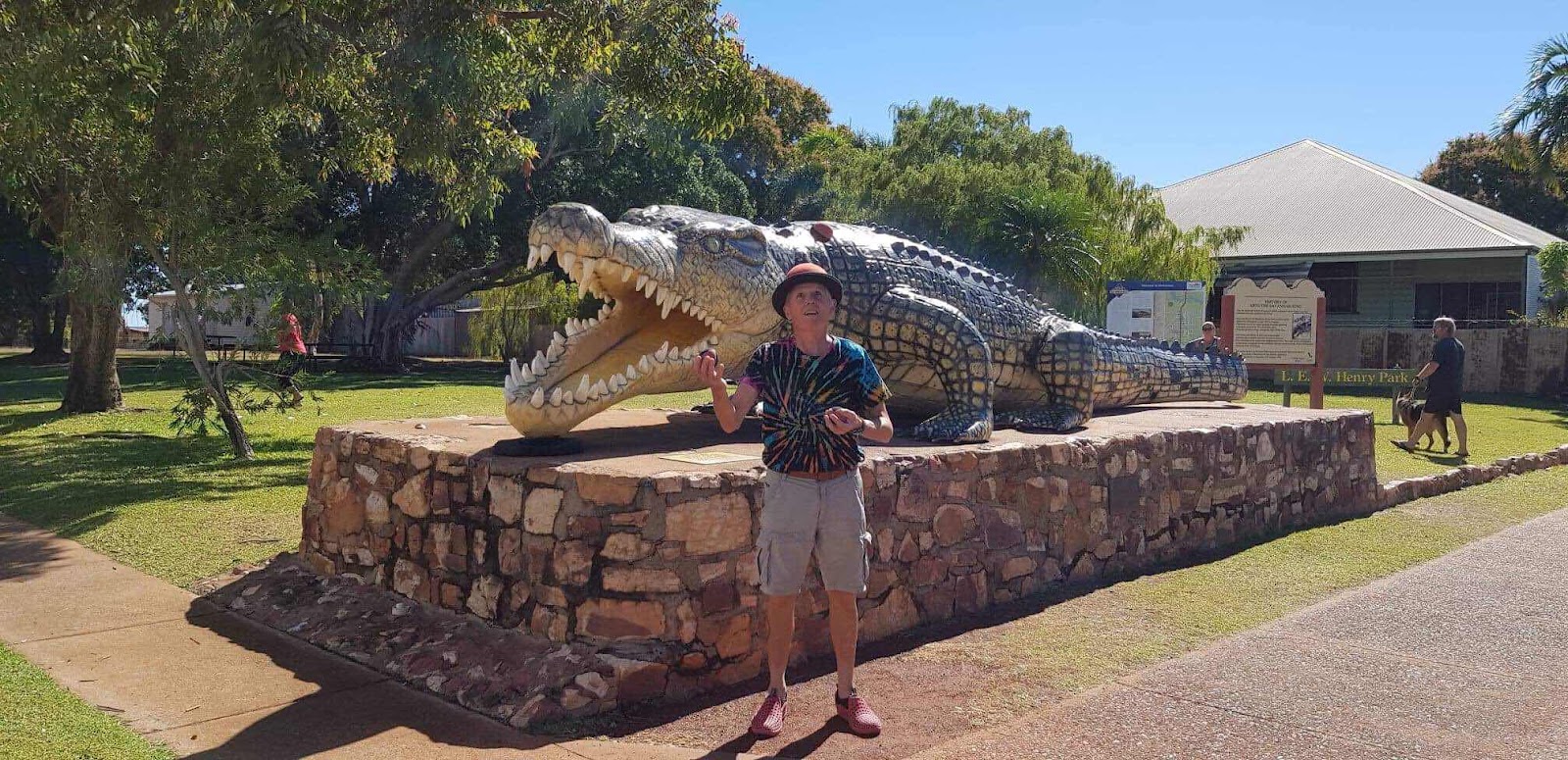
This is not a good place for a swim as they do have Salties (salt water crocodiles) in this area.

Tho this guy doesn’t seem to mind getting into the water.

No matter where I go in Australia I always see something I’ve never seen before, which is very interesting.

Tho this guy doesn’t seem to mind getting into the water.
No matter where I go in Australia I always see something I’ve never seen before, which is very interesting.
Unicycles allowed .....except 1950 Scotsmen!

Just over the horizon may be Borneo or Bali.
I wait for the sunset and do some whistle practise.

Karumba is quite a little tourist spot with many caravan parks and also a good fish’n’chip shop, so what’s to do but watch the sun go down with barramundi and chips, and jump for joy all at the same time.

There were a lot of tourists also parked up on the beach to view this sunset.

5 minutes after the sun dipped into the sea all the other tourists disappeared, while we just sat for another 20 minutes watching and taking photos of nature’s beauty.


5 minutes after the sun dipped into the sea all the other tourists disappeared, while we just sat for another 20 minutes watching and taking photos of nature’s beauty.
We also visited the Barramundi Visitor Centre in Karumba, what an impressive new building.

My word, I had no idea that it’s such a legendary fish with massive significance to this area’s prosperity.

I just had to take this shot, I haven’t got over the colour of the soil in Australia, and yes it’s everywhere and colours everything red.

Leaving Normanton Christine took the Gulflander train, while I drove the car and van 5hrs to Croydon. This railway line is of a different gauge (3ft6in) to all the other rail lines in Australia, therefore it is a separate line which was used for servicing the gold strikes in Croydon, Normanton and its surrounding areas. The locals say it runs from nowhere to nowhere as it is not connected to any other Queensland lines.


This is the mail being delivered by train driver. The Station gate beside the railway line is 30km from the homestead.
Mail is also picked up on the return journey if the flag is raised.

The railway was built to transport gold and people from Croydon to the port at Normanton.
At its peak it moved over 10,000 people each year.
Some spare wheels outside, a bit too heavy to pinch as a souvenir.

I met Christine in Croydon which turned out to be a lovely little town full of history, with a great info centre called the True Blue Info Centre. There are a lot of steel sculptures all around the town, built by Artist Blacksmith Hans Pehl. Croydon was once 8 km long and had 32 pubs. The gold strike was an open seam type of gold but it ran out fairly quickly, and Croydon returned to just servicing the cattle stations in this area.
Below is a well used gold mould .

Hans’s sculptures really do give an arty flavour to this little town.


They certainly didn’t have this sort of activity in Croydon in the 1890s.

We moved further East to the Lava tubes at Undara. This is a cattle station still owned by the Collins family for 6 generations from 1862. who realised the tourist potential and uniqueness of the geology and turned it into a tourist attraction.
The Undara Lava Tubes were formed when 23 cubic kilometres of lava from one of the many volcanoes spilled out over the land and travelled along a river bed. The tubes were formed when the outer layer formed a crust which protected the still-molten lava which continued to flow as though it was in a tube or a pipe.


Christine spotted this coffee sign at Mt Surprise.

I took the Wind Tunnel tour, while Christine took the Arches tour.
Beck our tour guide from the Cape York region was one of the newer guides, and did a great job.

Believe it or not, this huge mound of rocks and dirt is created by the Bush (or Brush) Turkey for its nest!

The Lava tubes were pretty impressive, I asked why the Aboriginal don’t appear to have used them, it has only recently been found out (in the last two weeks) that they did, because stones that were found in the caves from an other region of Australia.


Believe it or not, this huge mound of rocks and dirt is created by the Bush (or Brush) Turkey for its nest!
The Lava tubes were pretty impressive, I asked why the Aboriginal don’t appear to have used them, it has only recently been found out (in the last two weeks) that they did, because stones that were found in the caves from an other region of Australia.
Undara is also famous for its use of old railway carriages which apparently cost over $1Million to buy in 1980’s.
The word Undara in the Aboriginal language means “a long way”.
This unique venue hosts two annual events - Opera in the Outback and the Undara Outback Rock and Blues festival.
We only stayed the one night at Undara, in spite of it being a very nice camp (and our neighbours were Kiwis). We were keen to get moving towards the Tablelands.
Christine spotted this coffee sign at Mt Surprise.
This brings blog #10 to a close.
Plenty more up ahead!
Stay safe and free and be creative.
Cheers Jimu & Christine.
.